Automotive Clutch and Release Bearing Guide
Overview of clutch and release bearing
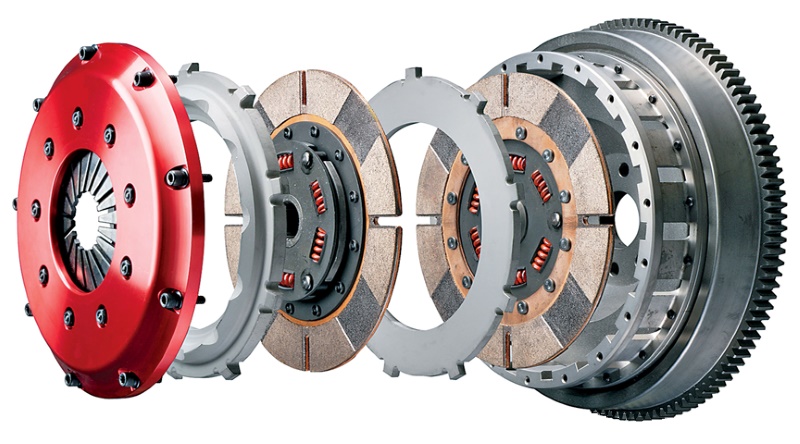
Clutch composition
The main components of the clutch include the active part, the driven part, the pressing part and the operating mechanism.
Active Part (Drive Plate): Also called the flywheel or drive plate, attached to the engine’s crankshaft. The active section transmits the power generated by the engine through the crankshaft.
Driven part (Driven plate): Also called friction plate or friction plate, it is connected to the input shaft of the transmission. The driven part contacts the driving part through friction and transmits power to the transmission.
Pressing part (Pressure Plate): The pressing part tightly combines the driven part and the driving part through the pressure plate and pressure plate. The pressure plate compresses the clutch discs through pressure on the clutch pressure plate, thereby ensuring a secure connection by friction.
The Operating Mechanism: The operating mechanism includes the clutch pedal, release lever, adjustment fork, release bearing and return spring, etc., which are used to control the separation and combination of the clutch.
In addition, for a hydraulic clutch, its operating mechanism also includes a hydraulic system, which transmits pressure through hydraulic oil to realize the separation and combination of the clutch. The hydraulic system of a hydraulic clutch usually consists of a master cylinder, a slave cylinder, oil pipes and cylinders.
Clutch operating mechanism
The clutch operating mechanism is a set of mechanisms by which the driver disengages the clutch and then combines it softly. It starts at the clutch pedal and ends at the release bearing within the clutch.
According to the operating energy required to separate the clutch, there are two types of clutch operating mechanisms: manual and pneumatic. The former uses the driver’s body as the only control energy source, while the latter uses the engine-driven air compressor as the main control energy source, and the human body as the auxiliary and backup control energy source.
Human-operated operating mechanisms are divided according to the form of the transmission device used, and there are two types: mechanical and hydraulic.
Release bearing overview:
The release bearing is an important component in the automobile clutch and is usually installed between the clutch and transmission. Its main function is to separate the clutch pressure plate and clutch friction plate when the clutch is disengaged, thereby achieving the separation of the engine and transmission.
The working principle of the release bearing is to realize the combination or disconnection between the automobile engine and the transmission system through the axial movement of the bearing. In operations such as starting, shifting, and parking the car, the release bearing plays a vital role. It can make the car start, shift, and stop smoothly, and it also plays a certain protective role in overloading the car’s transmission system.
Mechanical release bearings and hydraulic release bearings are used in mechanical clutches and hydraulic clutches respectively.
Mechanical clutch and mechanical release bearing

Mechanical clutch: This type of clutch transmits the clutch operating force through mechanical means, usually a cable or rod. Mechanical clutches are generally heavier and require greater pedal force to operate.
MechanicalChassis clutch release bearing:Bearing that acts on the car clutch release finger (rod) to separate and engage the clutch
In a mechanical clutch system, there is usually a release bearing (also called a clutch bearing) located between the clutch pressure plates. This bearing is located behind the clutch pressure plate, adjacent to the flywheel in the driveline.
Mechanical clutch
Basic structure of mechanical clutch
Active part: The engine crankshaft generates power through rotation and acts as the active part of the mechanical clutch.
The pressure plate is driven by the engine crankshaft and is connected to the engine crankshaft through bolts or pressure plates. When the clutch is working, it presses the clutch plate to transmit power.
Driven part: The clutch plate is the driven part of the mechanical clutch, which receives the pressure from the pressure plate and transmits it to the transmission.
When the pressure plate presses against the clutch disc, the clutch disc rotates synchronously with the engine crankshaft, thereby transmitting power to the transmission.
Pressing part: In a mechanical clutch, the pressing portion consists of one or more pressure plates, usually made of metal.
The pressure plate is connected to the engine crankshaft through bolts or pressure plates, and presses the clutch plate to achieve the clutch state.
When the clutch pedal is depressed, the pressure plate moves, causing the clutch plate to separate from the engine crankshaft and reach the clutch state.
Operating mechanism: The operating mechanism of a mechanical clutch is mainly composed of a pedal, a cable, a release bearing, a clutch pressure plate and a clutch plate. When the clutch pedal is depressed, the clutch pedal pulls the release bearing through the cable, causing the clutch plate and flywheel to separate, thereby cutting off the power.
- Clutch Pedal: Located in the cab, the driver steps on it to operate the clutch.
- Linkage Rod: Connects the clutch pedal and the pressure plate, transmitting the driver’s pedaling action to the pressure plate.
- Pressure plate lever (Release Lever): Located on the engine side, it connects the pressure plate and connecting rod. When the driver depresses the clutch pedal, the connecting rod transmits the movement to the pressure plate rod, and the movement of the pressure plate rod separates the pressure plate from the clutch plate, thereby achieving the clutch state.
- Release Bearing: Located at one end of the pressure plate rod, when the pressure plate rod moves, the release bearing is responsible for contacting the pressure plate and separating it from the clutch plate to achieve the clutch state.

Working principle of mechanical clutch
- Clutch state: When the driver releases the clutch pedal, the pressure plate exerts force through the pressure plate rod or pressure plate to compress the clutch plate and flywheel, causing them to rotate together, thereby transmitting the engine’s power to the transmission and wheels to achieve normal vehicle operation. travel.
- Transmission state: When the driver depresses the clutch pedal, the pressure plate separates from the clutch plate, causing the clutch plate to separate from the rotation of the engine, thus cutting off the power transmission between the engine and the transmission. In this state, the vehicle is in neutral and the engine’s power is no longer transmitted to the wheels.
Mechanical release bearing
Basic structure of mechanical release bearing

The structural design of mechanical release bearings usually relies more on mechanical devices to achieve bearing separation. Specific designs can include the following components:
- Inner and outer rings (or raceways): Similar to hydraulic release bearings, mechanical release bearings also include inner and outer rings to support and position the rolling elements.
- Rolling elements: Like hydraulic release bearings, mechanical release bearings also require rolling elements to reduce friction.
- Release mechanism: This is a key component of a mechanical release bearing, usually consisting of springs, blades or other mechanical structures. These separation mechanisms use mechanical principles to maintain a certain gap between the rolling elements and the raceways when the bearing is running, thereby reducing friction and wear.
Working principle of mechanical release bearing
The working principle of the mechanical release bearing is to control the separation and combination of the clutch through mechanical means such as pedals. When the clutch pedal is depressed, the clutch pressure plate pulls the release bearing through the cable, causing the clutch plate and flywheel to separate, thereby cutting off the power. Mechanical release bearings are usually manually operated and have the advantages of simple structure and low cost, but they require the driver to have certain operating skills and strength.
- Connected state: When the clutch is connected, the release bearings are squeezed together by the clutch pressure plate to transmit the engine’s power to the transmission to drive the wheels.
- Disengagement state: When the driver depresses the clutch pedal, the force between the clutch pressure plate and the release bearing will reduce or disappear, so that the clutch pressure plate no longer presses the release bearing tightly. This causes the release bearing to no longer transmit power, causing the engine to separate from the transmission. At this time, the driver can smoothly shift gears or stop the vehicle.
Hydraulic clutch and hydraulic release bearing

Hydraulic clutch: A hydraulic clutch transmits clutch operating force through a hydraulic system. Hydraulic clutches are typically lighter and require less operating force because the hydraulic system can provide a greater leverage ratio.
Hydraulic clutch release bearing: A clutch release bearing that realizes clutch separation and engagement under the action of fluid pressure.
In a hydraulic clutch system, the release bearing is usually located above or inside the piston of the clutch cylinder, adjacent to the pressure plate. The function of this bearing is similar to the release bearing in a mechanical clutch, used to separate the connection between the pressure plate and the engine.
Hydraulic clutch
Basic structure of hydraulic clutch
Active part: The engine crankshaft generates power through rotation and serves as the active part of the hydraulic clutch.
The hydraulic cylinder in the hydraulic clutch plays the role of the active part here. It converts the pressure generated by the master cylinder into the moving force of the piston through the hydraulic principle, thereby pushing the pressure plate to separate or connect with the clutch plate.
Driven part: The clutch plate is also the driven part of the hydraulic clutch. It receives the driving force of the hydraulic cylinder and transmits it to the transmission.
When the hydraulic cylinder pushes the pressure plate to separate the clutch plate, the clutch plate and the engine crankshaft no longer rotate synchronously, thereby achieving a clutch state and power is no longer transmitted to the transmission.
Pressing part: In a hydraulic clutch, the pressing part is also composed of one or more pressure plates, and its structure is similar to the pressure plate in a mechanical clutch.
The difference is that the pressing part of the hydraulic clutch is controlled by a hydraulic cylinder, and is pressed or released through the hydraulic principle.
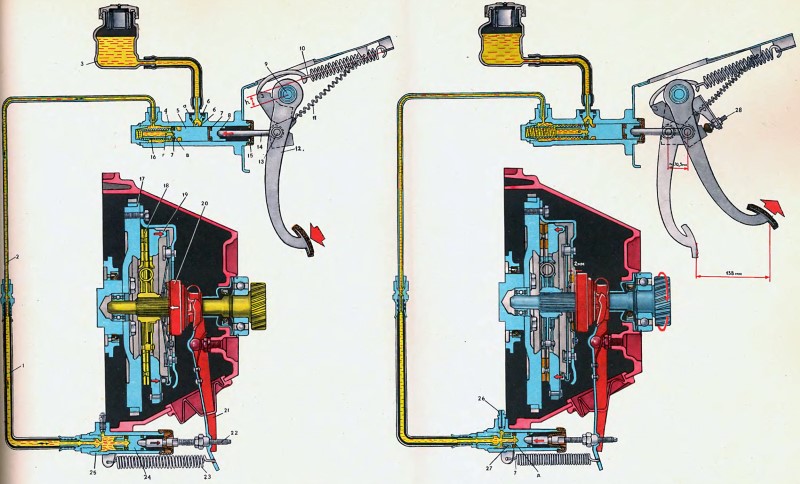
When the driver depresses the clutch pedal, the master cylinder generates hydraulic pressure, which is transmitted to the hydraulic cylinder through the liquid. The piston of the hydraulic cylinder moves, pushing the pressure plate away from the clutch plate to achieve the clutch state.
Operating mechanism: The operating mechanism of the hydraulic clutch consists of the clutch master cylinder, clutch slave cylinder, release bearing, pressure plate, clutch plate and hydraulic system. When the clutch pedal is depressed, the clutch master cylinder generates oil pressure, which is transmitted to the slave cylinder through the hydraulic system, pushing the release bearing to separate the clutch plates.
- Clutch Pedal: Same as the mechanical clutch, it is located in the cab and is operated by the driver when he steps down.
- Master Cylinder: Located near the clutch pedal, hydraulic pressure is generated by the driver’s pedaling action.
- Hydraulic Lines: Transmit the hydraulic pressure generated by the master cylinder to the hydraulic cylinder.
- Hydraulic Cylinder: Located near the pressure plate of the clutch, it receives hydraulic pressure and converts it into moving force of the piston.
- Hydraulic Release Bearing: Controlled by a hydraulic cylinder, when the driver depresses the clutch pedal, the force on the bearing is released, pushing the pressure plate away from the clutch plate to achieve the clutch state.
Working principle of hydraulic clutch
- Clutch state: When the driver releases the clutch pedal, the master cylinder generates hydraulic pressure and transmits the pressure to the hydraulic cylinder. The piston of the hydraulic cylinder moves and pushes the pressure plate away from the clutch plate to achieve the clutch state. In this way, the power of the engine is no longer transmitted to the transmission, the wheels are no longer driven by power, and the vehicle is in neutral.
- Transmission status: When the driver depresses the clutch pedal, the master cylinder stops generating pressure, and the piston of the hydraulic cylinder returns, causing the pressure plate to press the clutch plate again, causing it to rotate synchronously with the engine, and ultimately drive the wheels to rotate, achieving normal vehicle operation. travel.
Hydraulic release bearing
Basic structure of hydraulic release bearing
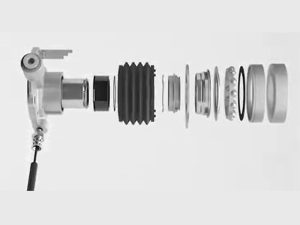
Hydraulic release bearings rely more on the pressure generated by the liquid medium to achieve bearing separation.
- Inner and outer rings (or raceways): The inner and outer rings are usually made of metal and are used to support and position the rolling elements in the bearing.
- Rolling elements: usually needle rollers, balls or rollers, etc., used to roll between the inner and outer rings to reduce friction.
- Hydraulic chamber: The hydraulic chamber is one of the core components of the hydraulic release bearing, which is filled with liquid medium (such as hydraulic oil). When the liquid medium is under pressure, a pressure area is formed inside the bearing, which separates the rolling elements from the raceway, thereby reducing friction and wear.
Sealing device: used to keep the liquid in the hydraulic chamber from leaking and to prevent external contaminants from entering the inside of the bearing.
Working principle of hydraulic release bearing
The working principle of the hydraulic release bearing is to transmit pressure and control the separation and combination of the clutch through the hydraulic system. When the clutch pedal is depressed, the hydraulic system generates oil pressure, which transmits pressure through the hydraulic oil and pushes the piston to move, causing the pressure plate to separate or combine with the engine crankshaft. Hydraulic release bearings have the advantages of fast response, high precision, and light operation, but they require regular maintenance and upkeep to ensure their normal operation.
- Connected state: When the hydraulic clutch is in the connected state, the hydraulic system applies hydraulic pressure to the clutch hydraulic cylinder, which causes the piston in the hydraulic cylinder to apply force to the pressure plate, connecting the pressure plate and the flywheel together, thus realizing the connection between the engine and the transmission. of transmission.
- Disengagement state: When the driver needs to disengage the engine and transmission, the hydraulic system will reduce or interrupt the hydraulic pressure applied to the clutch hydraulic cylinder. This causes the piston in the clutch hydraulic cylinder to reduce the force or move to a position that separates the pressure plate from the engine and stops power transmission.